Sunday, October 22, 2017

Effectiveness of the Dayton Accords

Effectiveness of the Dayton Accords
Since the signing of the Dayton Agreement in 1995, there has not been a significant conflict among the Serbs, Croats, and Bosnians. This is, in part, thanks to the UN peacekeeping forces in the area. These peacekeepers are merely a guardian of these three ethnic groups and are using the Dayton Agreement to keep the Serbs, Croats, and Bosnians in a prolonged timeout. Taking a realist perspective, I believe that the reemergence of conflict between these three ethnic groups is inevitable.
It is a common belief that the Bosnian conflict was caused by ethnic strife between the Serbs, Croats, and Bosnians. This may have been an underlying factor. However, I argue that a small dislike of another group was turned into a political tool by the leaders of each state involved. Often times political actors would act more moderate to get voted into office, but once in office, would take a more nationalist approach and preach ethnic superiority. Thus, ethnic strife increased as more extremist-view people were given power.
Now, almost 22 years after the signing of the Dayton Agreement, these preachings have slowly diminished. However, like terrorist ideology, this propaganda and beliefs will never completely disappear. All it takes is another ethnic extremist to take over, and the ethical cleansings that happened during the ‘90s will begin again.  
Drawing upon historic events, Hitler rose to power due to the country’s economic depression, the people’s lack of confidence in the current government, and most importantly, the country’s hatred of the Treaty of Versailles. In regard to the Treaty of Versailles, many German nationalists and veterans believed the war could have been one if they had not been betrayed by protesters and politicians. These animosities during the years after World War I created the perfect environment for Hitler to rise to power.
I would argue that a similar situation could potentially happen in the Balkan region. The Dayton Accords was a United States backed peace talk/agreement. The lone hegemon in the world arguably forced the three leaders to discuss a peace agreement. This most likely created some anger among the three ethnicities because an outside actor was making them go about their conflict in a different way, instead of letting them figure it out for themselves. Also, it took Hitler 14 years after the Treaty of Versailles was signed to become chancellor. Therefore, this rise to power in the former Yugoslavia area will take time to happen.
Even if there wasn’t a major ethnic hatred among the three groups before the Bosnian conflict, there is probably a larger dislike now due to the atrocities committed during the conflict. Like Hitler with his Antisemitism, it is quite possible a new leader will try and succeed in bringing these hatreds out once more. Making this even more possible is the fact that in the past, political actors have acted less radical in order to get elected, and then presenting their more nationalist views once in office.

The Dayton Agreement did not end the conflict between the Serbs, Croats, and Bosnians, it simply suspended the fighting. Also, this conflict was not the end-all for ethnic tensions in the region, but rather, due to the ethnic cleansings that took place, made them even deeper. All it takes is one leader from any of the three ethnicities to insert nationalist ideals into the heads of his or her people to begin another conflict between the three major ethnic groups.  

North Korea and Foreign Relations

Ally Tompkins
Global Security Studies 
Professor Shirk
                                                   North Korea and Foreign Relations

As the Kim regime has gained control over North Korea, their cult of personality has consumed the ideologies of the populace. In maintaining their unpredictable reputation, each leader (currently Kim Jong-un) has preserved their oppressive rule over the state. Therefore, it is difficult to determine how many of the citizens of North Korea believe the propaganda that the regime provides and how, if the United States were to end the regime, people would react to a world without the Kim family. Thus, the United States is forced to determine the viability of the nation’s threats and nuclear power in order to establish a plan for further actions. The most recent approach known as strategic patience seems the most practical for current foreign relations, as it avoids the consequence from any potentially destructive activity.
The Kim family has become known for their outlandish claims surrounding their personas. From creating a reputation for Kim Jong-il as a fashion icon, to asserting that the rest of the world loves North Korea, the country’s leaders have forged a nation built on lies. In a completely artificial world, it is difficult to tell whether those who live there believe the words of their dictator and to what extent. Therefore, it is difficult to measure how to intervene with the nation’s leadership if after the fall of the regime there is a nation of distraught citizens with a secluded view of the actual world. It is difficult to keep a nation locked in fear and to garner the attention of major world powers, thus there is a danger in dismissing the rationality of a leader such as Kim Jong-un. Anna Fifield of The Washington Post notes that “Leaders throughout the centuries have realized it can be advantageous to have your enemies think you're crazy”, which she argues has been beneficial for the North Korean dictator. While it is evident that the decisions he makes are not good or beneficial for his people, it can easily be argued that they are rational. For example, he has been able to maintain power as he incited fear in the people of his country. A political cartoon by Rick Mckee depicts the North Korean leader as a child, drawing up his plan of attack on the Americans with crayons. Ofttimes Jong-un is dismissed as an immature child because of his anarchic behavior, yet it must be considered that their is a method behind his madness. While his actions may not be seen by members of a democratic state as rational, he has utilized his system of dread and disorder has allowed him to maintain his power to this day.

Therefore, it puts nations such as the United States in a burdensome situation in dealing with the nation. Beginning in 2003, the U.S., China, Russia, Japan, South Korea, and North Korea began engaging in meetings known as “Six Party Talks”(Lecture 10). While the framework for the talks still exist, there has not been a talk since 2009. Due to North Korea’s strong intent to build nuclear weapons, the ability to reason with the nation has lessened. If the talks were to change to those with five parties, it could lead to anger from North Korea. Therefore, engaging in such a system would not be beneficial for those involved, as it would only lead to irritation from the excluded party. Taking any drastic actions towards North Korea would risk great casualties amongst both the infiltrators and North Korea itself. Currently, the United states and other nations are preoccupied with North Korea’s intent on building up their nuclear weapons program. However, the human security issue in the country serves as a great problem as well. Yet, with the current regime in power, there are few options to take action against the human rights violations of the nation. Due to all of the risks associated with a definitive action, for now it seems that the best option is to wait. Few options at this point seem viable. In order to take down the regime, there must be a strategic element associated with timing. Similarly, the United States does not want to be responsible for beginning a war that could potentially be nuclear. Therefore, it is important that the United States take a step back to evaluate their options in order to take action when the timing is right. Ally Tompkins

Global Security Studies 
Professor Shirk

As the Kim regime has gained control over North Korea, their cult of personality has consumed the ideologies of the populace. In maintaining their unpredictable reputation, each leader (currently Kim Jong-un) has preserved their oppressive rule over the state. Therefore, it is difficult to determine how many of the citizens of North Korea believe the propaganda that the regime provides and how, if the United States were to end the regime, people would react to a world without the Kim family. Thus, the United States is forced to determine the viability of the nation’s threats and nuclear power in order to establish a plan for further actions. The most recent approach known as strategic patience seems the most practical for current foreign relations, as it avoids the consequence from any potentially destructive activity.
The Kim family has become known for their outlandish claims surrounding their personas. From creating a reputation for Kim Jong-il as a fashion icon, to asserting that the rest of the world loves North Korea, the country’s leaders have forged a nation built on lies. In a completely artificial world, it is difficult to tell whether those who live there believe the words of their dictator and to what extent. Therefore, it is difficult to measure how to intervene with the nation’s leadership if after the fall of the regime there is a nation of distraught citizens with a secluded view of the actual world. It is difficult to keep a nation locked in fear and to garner the attention of major world powers, thus there is a danger in dismissing the rationality of a leader such as Kim Jong-un. Anna Fifield of The Washington Post notes that “Leaders throughout the centuries have realized it can be advantageous to have your enemies think you're crazy”, which she argues has been beneficial for the North Korean dictator. While it is evident that the decisions he makes are not good or beneficial for his people, it can easily be argued that they are rational. For example, he has been able to maintain power as he incited fear in the people of his country. A political cartoon by Rick Mckee depicts the North Korean leader as a child, drawing up his plan of attack on the Americans with crayons. Ofttimes Jong-un is dismissed as an immature child because of his anarchic behavior, yet it must be considered that their is a method behind his madness. While his actions may not be seen by members of a democratic state as rational, he has utilized his system of dread and disorder has allowed him to maintain his power to this day.
Therefore, it puts nations such as the United States in a burdensome situation in dealing with the nation. Beginning in 2003, the U.S., China, Russia, Japan, South Korea, and North Korea began engaging in meetings known as “Six Party Talks”(Lecture 10). While the framework for the talks still exist, there has not been a talk since 2009. Due to North Korea’s strong intent to build nuclear weapons, the ability to reason with the nation has lessened. If the talks were to change to those with five parties, it could lead to anger from North Korea. Therefore, engaging in such a system would not be beneficial for those involved, as it would only lead to irritation from the excluded party. Taking any drastic actions towards North Korea would risk great casualties amongst both the infiltrators and North Korea itself. Currently, the United states and other nations are preoccupied with North Korea’s intent on building up their nuclear weapons program. However, the human security issue in the country serves as a great problem as well. Yet, with the current regime in power, there are few options to take action against the human rights violations of the nation. Due to all of the risks associated with a definitive action, for now it seems that the best option is to wait. Few options at this point seem viable. In order to take down the regime, there must be a strategic element associated with timing. Similarly, the United States does not want to be responsible for beginning a war that could potentially be nuclear. Therefore, it is important that the United States take a step back to evaluate their options in order to take action when the timing is right. 

Work Cited:
1.blogs.denverpost.com/opinion/files/2013/04/kim-cartoon-mckee.jpg.
2. Fifielder, Anna. “A Danger Lies in Underestimating North Korea.” Chicagotribune.com, www.chicagotribune.com/news/nationworld/ct-kim-jong-un-north-korea-20170325-story.html.
3.“How to Stop Kim Jong Un.” Time, time.com/north-korea-opinion/.

`

Sunday, October 1, 2017

The War on Terror

George W. Bush, a Baseball, and a Bullhorn


The attacks on September 11, 2001 spearheaded an identity crisis among the American people.  They were scared for and unsure of the future.  They were spiraling into wartime, they felt as if their everyday security was at risk, and they needed a place to turn for reassurance.  Luckily, the American people had the greatest political leader of the 21st century.  They had none other than President George W. Bush.  The man that had the Southern charm, the presidential smile, and an unmatched wit.  He was just your Uncle George and every time he spoke or addressed the nation, you felt that connection.  Now, what better was there to help mend an open ontological wound than someone with those characteristics?  George W. Bush’s response to the attacks on 9/11, barring opinions on the invasion of Iraq, makes him one of the greatest to ever hold the office.  It’s clear that President Bush’s record was quite shaky, considering the economic recession and other failed policy initiatives, but this is far beyond that.  When Gallup, Pew, Quinnipiac, and Monmouth call your house asking whether you view the President as favorable or unfavorable, you likely think of their personality first and foremost.
The beginning of the War on Terror, following the attacks, was not an easy thing to swallow for most Americans.  We saw enlistment rates in the military raise, but the thought of spending more time in war was not a very welcomed idea.  However, a response was absolutely necessary.  Yet, at the same time, President Bush and his calming, reassuring tone seemed to make everything alright.  There are two instances, in particular, that exemplify such a claim.
First, three days following the attacks, President Bush stood atop the rubble at Ground Zero with a bullhorn in his right hand and his left grabbing the shoulder of a mourning, ailing FDNY officer.  At this moment, he solidified himself as the most composed man in the face of the most unbearable and unbelievable adversity.  It was then that “Uncle George” spoke, off the cuff, to the most vulnerable in America.  And he did it as well as anyone had in history.  This, more or less, put to bed, any presidential one-liner that ever was.  This includes “fear itself,” “tear down this wall,” “ask not what your country can do,” and, every last “we’re gonna build a wall” that was to come in decades thereafter.  When President Bush said, “I can hear you.  The rest of the world hears you.  And the people who knocked these buildings down will hear all of us soon,” he bolstered and rejuvenated confidence that was at an all time low.
Second, about a month after September 11th, the President was asked to throw out the first pitch at the World Series.  He was asked to do so in Arizona, at the Diamondbacks’ home field, to lessen the possibility of any further threats or attacks.  However, he refused, and insisted that he throw out the first pitch at Yankee Stadium for Game 3, due to the Stadium’s location in New York City.  He knew that the people of New York needed this more than anything, and that baseball was the one thing that was going to truly unify them.  Well, President Bush took the mound and delivered a perfect strike.  That perfect strike was the most defining symbol of his leadership following 9/11.  His response, his addresses to the nation, his composure and resolve, and even his most informal of interactions were absolutely unprecedented in their class and grace.  Therefore, when I think of the War on Terror and it’s dawn, none other than President George W. Bush, a baseball, and a bullhorn come to mind.

Who Comes First, and What Comes Next?

Adam Steber
September 30, 2017
Prof. Mark Shirk
POL 331-A


Who Comes First, and What Comes Next?

The question of "what comes next" is a question that drives history forward. Making the right decision at these critical junctures can earn leaders an eternal, honored spot in history. Make the wrong choice, however, and the consequences can sometimes be steep enough to collapse an empire.
The Americans and their allies failed to consider the "what comes next" question time and time again in the Middle East, leading to catastrophic results in Iraq, Libya, and Egypt. Syria may prove to be another such case if the Americans oust Assad without thinking twice about "what comes next." Therefore, before deciding what to do in Syria, America should first question the motives of their current "allies."

America has tried to balance several Middle Eastern interests at a time, but due to the sheer number of interests they have with conflicting parties, they have stretched themselves out too thin. They cannot continue to arm the independence-seeking Kurds while expecting Turkey to harbor American nukes. They cannot be supporting Israel and Saudi Arabia politically while giving nuclear power to Iran. They cannot weaken Assad's rule on his own country without risking the swell of ISIS or al-Nusra controlled territory. And likewise, they cannot curb Russia's territorial ambitions diplomatically while bombing its Middle Eastern allies. In trying to balance all of these interests, the U.S. finds itself in a cat's cradle game where every possible decision ends in catastrophe--unless they switch up their strategy.

What is America to do, then, when there is seemingly no way out? The answer is to switch jerseys and defend Assad. Yes, America should aid the "bad guy," especially when Syrians themselves appear to support him. An Orthodox Christian in Syria gave his views on Assad in a 2011 al-Jazeera interview, when the Syrian Civil War was just beginning. According to article, the man said that he "did not support Assad's oppressive security apparatus, but under his rule he and his family were able to freely attend church mass each Sunday and celebrate Christian holidays like Christmas each year. He followed up by saying that he had no assurance that any other sect in Syria would protect the Syrian-Christian community" (Rafizadeh). Based on the man's testimony, it appears that in a post-Assad state, there are no guarantees to religious or ethnic minorities in Syria that they will be protected, and that freedoms such as freedom of religion may be eroded under a new leader. If the Americans act to stop Assad too quickly, they may do so while overriding the will of the Syrian people to determine their destiny--the argument The United States gives for fighting Assad.

Moreover, America's own allies are not so much allies as they are "enemies of my enemy." Turkey's loyalty to the West is shaky at best, given their takeover of Cyprus, their continued lobbying to enter the European Union, the refugee crisis, and most recently, the failed coup. The Kurds, meanwhile, are Marxist guerrillas who have provoked conflict in Iraq, Syria, and Turkey in their independence struggle. 70 years later, Israel continues to fight Palestine despite numerous attempts at a solution. Saudi Arabia continues to violate human rights with impunity, having only recently lifted the ban on women drivers. What company is there to keep with any of these powers?

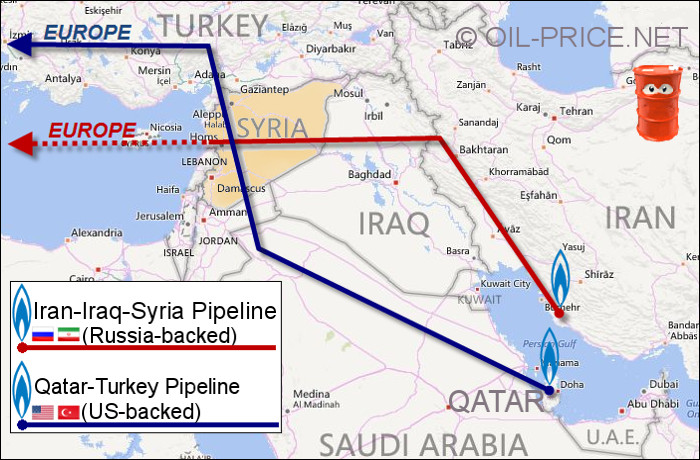
Oil, meanwhile, continues to be the defining factor in the Syria conflict. Given the pipeline map below, the geopolitical web seems to make more sense. Both Iran and Saudi Arabia, Shia and Sunni regional rivals, are proposing the construction of an oil pipeline flowing through friendly countries and into the West, which would provide a crucial economic boon. The pipelines intersect in Syria, where the two countries struggle over Sunni vs. Shia power to install a leader who will approve their pipeline. Thus, the true interest for Saudi Arabia and Iran in the country is oil. The importance of this is that in either event, a country with a poor human rights record will gain access to oil that will prop up their state. Therefore, The U.S. can only minimize the threat of Iran or Saudi Arabia. In the larger context, supporting Assad (and therefore Iran's pipeline) will minimize the damage more than supporting the Saudi-backed rebels. After all, Iran has fewer regional allies if Russia were taken out of the equation, and as a Shia country, it is opposed to ISIS and al-Nusra. The only other Shia powers than Iran are Assad and Hezbollah. Saudi Arabia, with its more powerful allies, may prove to be a greater threat in the region.

America's failure to support Assad is an international security threat. If Assad is overthrown by U.S. backed forces, the legitimacy of a foreign leader with popular backing will come into jeopardy, either because the U.S. violated the rule of law to install their own leader, or because ISIS will fill the ensuing power vacuum. In turn, America's reputation of a democratically advanced country respecting the rule of law will come into question, which will open a Pandora's box for other global powers (such as Russia or China) to follow suit. They have much to lose by backing the rebels, with little to gain except the temporary feel good notions of "supporting allies" while "spreading democracy" for a brief period of time before the other actors capitalize on the new situation. On the other hand, supporting Assad, distasteful as the idea may seem to the West, may be the best course of action for now.

Bibliography

1. Austin, Steve. “Oil Prices and the Syrian Civil War.” OilPricenet RSS, OIL-PRICE.NET, 14 Oct. 2015, 
www.oil-price.net/en/articles/oil-prices-and-syrian-civil-war.php.

2. “Map of Syrian Civil War/ Global Conflict in Syria.” Liveuamap, Liveuamap.com, 1 Oct. 2017, syria.liveuamap.com/en/time/15.03.

3. Rafizadeh, Majid. “For Syria's Minorities, Assad Is Security.” Al Jazeera English, Al Jazeera Media Network, 16 Sept. 2011, www.aljazeera.com/indepth/opinion/2011/09/2011912135213927196.html.


Oil pipeline map (Austin):

Map of Iran-Iraq-Syria pipeline and Qatar-Turkey pipeline

Helping or Hurting? : To What Extent Should the West Continue to Involve Itself in Middle Eastern Affairs?

The problems in the Middle East were not started by the west and doubtfully will ever be finished by them. Tensions dating back millennia to the Sunni- Shi’a split, have influenced the societies and territories of the Middle East to create when combined with external interests in Middle Eastern commodities such as oil, an extremely turbulent environment. However, despite not starting the problems, within the last couple decades the U.S. -along with many other western powers- has increasingly begun interfering with varying success and failure, with issues they felt posed threats to their allies, themselves or much of the world in general.  Thus, two questions arise: to what extent has the U.S./ western powers helped or hindered tense situations in the Middle East, and to what extent should it continue to involve itself in Middle Eastern problems? Neither question necessarily has a very straightforward answer. The U.S. and other western powers have interfered both positively and detrimentally on a relatively large scale, and are thus responsible at the minimum for defending themselves and aiding those whose home may become a stronghold for terrorism. Ideally the west would also be able to aid any other innocents suffering because of these tensions, however, as that often tends to lead to escalating tensions and further harm to innocents, perhaps the west should begin to shift to simply monitoring the rest of situation from afar as much as possible, intervening only when to help correct what it aided in damaging, and in other extremely necessary situations and doing so wisely, after calculating all possible risks and effects of their actions.
Many are aware of the extensive history of western interference in the Middle East, beginning with many European nations and their histories of colonialism, which often helped to create weakened/ failed states upon the removal of colonialism. Many of these states would later struggle with the rise of inter- (often over divisions in groups and the preference of certain groups by colonists, leading to anger and revolts after colonial exit: a problem also seen as far south as Rwanda during its civil war in the 1990's) and intra- state conflict as well as a rise in terrorism.
 Many also like to conceive of U.S. involvement in the Middle East as primarily beginning with President George H.W. Bush and his announcement of the ‘War on Terror’, with perhaps some inkling of involvement from the Carter and Reagan presidencies. In many ways this is a fair assessment, seeing as most of the tensions between the U.S. and the Middle East seem to have escalated to requiring military action during these eras. After all, it was Bush’s presidency that led to ‘Operation Restore Hope’ in Somalia, which failed to stop Mohamed Farah Aidid, and instead ended with several American soldiers and 1,000+ Somali's dead, in part due to Osama Bin Laden’s planning (a key figure in the escalation of terrorism, the creation of the ‘War on Terror’ and the birth of terrorist groups like ISIS), which solidified a more negative perception of the U.S. to Somalians. It was not the U.S.’s fault for Somalia becoming a failed state but interference that failed in Somalia to aid them may have helped to begin Somali piracy, through a possible general grouping of the U.S. with other western states who had exploited Somalia, leading to their struggles, and in many Somali mind’s ‘justifying’ their actions (before potential greed arose and continued the practice of piracy).
Other interference in Middle Eastern government structures from the west, further drew lines in the sand, with the U.S. -often an almost overactive participant in these interferences-  increasingly being placed on the side of enemy and target.  Decades before more modern, borderline overactive involvement, several presidents in the U.S. began -primarily through interference regarding Iran and Israel – meddling in the Middle East. At some point, this meddling began to become just a bit too much to further create positive results, such as the end of wars, and instead began to breed resentment towards the U.S., now grouped with either the rest of the west and their colonialist histories, or with groups in the Middle East who already had great tensions with other Middle Eastern groups (e.g. Sunni’s vs Shi’a's, Kurds, Israel vs Palestine, etc.). In many ways, this interference, the unseating of certain leaders and clear alignment with specific sides, helped to temporarily alleviate some problems, while creating others. Out of broken governments rose many terror groups who, without as many barriers to it, gained power more easily than they could have before, and who held a larger grudge against the U.S./ the west than ever before.
Overall, choices like the ‘War on Terror’ may have managed to create some good resolutions to some issues, but it also left many negative repercussions and helped to further paint dangerous targets on the U.S. Other western intervention, to some extent, helped repair some of the issues, but when paired with colonialist history, ultimately may have worsened others as well. At this point, the U.S. and much of the west needs to do its best to fix its mistakes, and if possible provide as much humanitarian aid/ security for innocents in the Middle East and abroad as possible. Unfortunately, however, the U.S. and the rest of the west also need to try and take as much of a step back as possible from overactive participation (especially in the case of the U.S.) to primarily monitoring for imminent, un-ignorable threats and acting then.
(Nick Danforth/Bipartisan Policy Center)
Map illustrating Middle Eastern states with a history of colonialism and major colonialization revolts. Many of the states with the strongest colonial control, had the strongest revolts against it, and have higher histories of terrorism, wars and violence.


Military Presence Post-ISIS

The United States military will never be able to pull out of the Middle East. This state has become too integrated in this region that leaving the area may cause everything gained within the last 15 plus years to collapse. Even when the end of ISIS comes, the extremist views will still exist and these extremist ideologies will always be a threat to the Western ways of life. Therefore, the War on Terror will be a never-ending battle against radical ideologies.
President George W. Bush started the infamous War on Terror when he stated, “[W]e will pursue nations that provide aid or safe haven to terrorism…” (Jones).  Little did Bush know, this so-called war would be a seemingly endless fight to implement democracy in places where the citizens have little interest in it. The majority of the Middle East see the Quran as the way things ought to be. The teachings in Quran clash with the ideas of democracy in major ways, such as separation of Church and State. Also, a lot of the radical ideologies develop from teachings in the Quran. Consequently, there is no way to stop these interpretations from being put forth unless the Quran gets destroyed. This however, is impractical and will problem cause even more of an uproar.
Similarly, these interpretations/ideologies will not be destroyed once a certain group or even state is demolished. ISIS may be on the decline but this does not mean their beliefs are dying with them. These extremist ideologies are now deeply imbedded into the minds of civilians, and will continue to influence their actions. Furthermore, it is quite possible that an ex-affiliate of ISIS will go off and create his own ideological terrorist group that could be even more threatening to the United States and its allies.  
Therefore, to prevent these extremists from regrouping and terrorizing western ideals, the United States will have to stay in these areas to act as an unofficial police force to ensure no insurgencies try to form and attack westernized countries. This does mean military presence is needed. There are roughly 30,000 United States military personnel spread across the Middle East at the moment (2017 Index of U.S. Military Strength). These troops’ main focus should be on identifying extremist bunkers and eliminating them. Simply bombing these areas does not ensure that the targets will be killed. Sending in soldiers will ensure that the target is identified and killed.
This does raise the risk of more military deaths, but it is a risk that needs to be taken. Leaving the Middle East after the defeat of ISIS will be an open invitation for any other group that wishes to take over. There cannot be a repeat of what happened when the United States pulled out of Iraq. United States’ troops left Iraq before it was ready to fend for itself, allowing ISIS to gain power and land in a decent chunk of the country (Mansour). This created a more global problem for the United States compared to the more localized problem that American troops were dealing with in Iraq at the time.   

There will never be peace and unity in the Middle East. There are way too many ideologies and beliefs that clash with one another. To ensure none of these groups with extremist views attack or threaten other ways of life, the United States needs to be there and act as a sort of peacekeeper. This won’t fix every single problem but it will increase the likelihood of keeping the ideologies contained.

Revisiting Security Essay

Andrew Tammaro Revisiting Security Essay At the start of this class, I had a very limited view of security and how it impacts the dail...