Adam Steber
September 30, 2017
Prof. Mark Shirk
POL 331-A
Who Comes First, and What Comes Next?
The question of "what comes next" is a question that drives history forward. Making the right decision at these critical junctures can earn leaders an eternal, honored spot in history. Make the wrong choice, however, and the consequences can sometimes be steep enough to collapse an empire.
The Americans and their allies failed to consider the "what comes next" question time and time again in the Middle East, leading to catastrophic results in Iraq, Libya, and Egypt. Syria may prove to be another such case if the Americans oust Assad without thinking twice about "what comes next." Therefore, before deciding what to do in Syria, America should first question the motives of their current "allies."
America has tried to balance several Middle Eastern interests at a time, but due to the sheer number of interests they have with conflicting parties, they have stretched themselves out too thin. They cannot continue to arm the independence-seeking Kurds while expecting Turkey to harbor American nukes. They cannot be supporting Israel and Saudi Arabia politically while giving nuclear power to Iran. They cannot weaken Assad's rule on his own country without risking the swell of ISIS or al-Nusra controlled territory. And likewise, they cannot curb Russia's territorial ambitions diplomatically while bombing its Middle Eastern allies. In trying to balance all of these interests, the U.S. finds itself in a cat's cradle game where every possible decision ends in catastrophe--unless they switch up their strategy.
What is America to do, then, when there is seemingly no way out? The answer is to switch jerseys and defend Assad. Yes, America should aid the "bad guy," especially when Syrians themselves appear to support him. An Orthodox Christian in Syria gave his views on Assad in a 2011 al-Jazeera interview, when the Syrian Civil War was just beginning. According to article, the man said that he "did not support Assad's oppressive security apparatus, but under his rule he and his family were able to freely attend church mass each Sunday and celebrate Christian holidays like Christmas each year. He followed up by saying that he had no assurance that any other sect in Syria would protect the Syrian-Christian community" (Rafizadeh). Based on the man's testimony, it appears that in a post-Assad state, there are no guarantees to religious or ethnic minorities in Syria that they will be protected, and that freedoms such as freedom of religion may be eroded under a new leader. If the Americans act to stop Assad too quickly, they may do so while overriding the will of the Syrian people to determine their destiny--the argument The United States gives for fighting Assad.
Moreover, America's own allies are not so much allies as they are "enemies of my enemy." Turkey's loyalty to the West is shaky at best, given their takeover of Cyprus, their continued lobbying to enter the European Union, the refugee crisis, and most recently, the failed coup. The Kurds, meanwhile, are Marxist guerrillas who have provoked conflict in Iraq, Syria, and Turkey in their independence struggle. 70 years later, Israel continues to fight Palestine despite numerous attempts at a solution. Saudi Arabia continues to violate human rights with impunity, having only recently lifted the ban on women drivers. What company is there to keep with any of these powers?
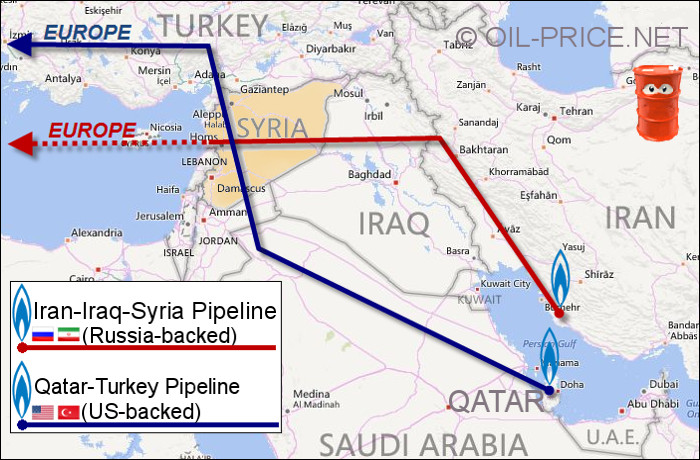
Oil, meanwhile, continues to be the defining factor in the Syria conflict. Given the pipeline map below, the geopolitical web seems to make more sense. Both Iran and Saudi Arabia, Shia and Sunni regional rivals, are proposing the construction of an oil pipeline flowing through friendly countries and into the West, which would provide a crucial economic boon. The pipelines intersect in Syria, where the two countries struggle over Sunni vs. Shia power to install a leader who will approve their pipeline. Thus, the true interest for Saudi Arabia and Iran in the country is oil. The importance of this is that in either event, a country with a poor human rights record will gain access to oil that will prop up their state. Therefore, The U.S. can only minimize the threat of Iran or Saudi Arabia. In the larger context, supporting Assad (and therefore Iran's pipeline) will minimize the damage more than supporting the Saudi-backed rebels. After all, Iran has fewer regional allies if Russia were taken out of the equation, and as a Shia country, it is opposed to ISIS and al-Nusra. The only other Shia powers than Iran are Assad and Hezbollah. Saudi Arabia, with its more powerful allies, may prove to be a greater threat in the region.
America's failure to support Assad is an international security threat. If Assad is overthrown by U.S. backed forces, the legitimacy of a foreign leader with popular backing will come into jeopardy, either because the U.S. violated the rule of law to install their own leader, or because ISIS will fill the ensuing power vacuum. In turn, America's reputation of a democratically advanced country respecting the rule of law will come into question, which will open a Pandora's box for other global powers (such as Russia or China) to follow suit. They have much to lose by backing the rebels, with little to gain except the temporary feel good notions of "supporting allies" while "spreading democracy" for a brief period of time before the other actors capitalize on the new situation. On the other hand, supporting Assad, distasteful as the idea may seem to the West, may be the best course of action for now.
Bibliography
1. Austin, Steve. “Oil Prices and the Syrian Civil War.” OilPricenet RSS, OIL-PRICE.NET, 14 Oct. 2015,
www.oil-price.net/en/articles/oil-prices-and-syrian-civil-war.php.
2. “Map of Syrian Civil War/ Global Conflict in Syria.” Liveuamap, Liveuamap.com, 1 Oct. 2017, syria.liveuamap.com/en/time/15.03.
3. Rafizadeh, Majid. “For Syria's Minorities, Assad Is Security.” Al Jazeera English, Al Jazeera Media Network, 16 Sept. 2011, www.aljazeera.com/indepth/opinion/2011/09/2011912135213927196.html.
Oil pipeline map (Austin):

I agree with your statements that the U.S. has spread its Middle Eastern interests too thin, that it has often failed to properly ask itself 'what comes next?' and that many of its alliances are shaky, based around oil trade/ general geo-political advantages and ignoring a fair amount of wrongdoing. I however, also feel that perhaps many of these alliances may stem from the fact that several of the U.S.'s allies are very powerful; regimes with long histories, great wealth from oil trade that would still continue to be substantial even if for some reason the U.S. no longer needed to trade with them, and large amounts of armed forces, official and unofficial. Perhaps many of these alliances also serve to protect us, from those outside of our allies, to our allies themselves (if they are our allies they are less likely to become threats in the immediate future). I also hesitate to share your views on Assad. For every comment of praise, there are countless of fear, hatred and condemnation (especially for his acts of chemical warfare against his own people,and incitement of civil war in the name of maintaining his own power and not meeting the fate of other leader's such as Hosni Mubarak's overthrow). I can understand your view that ISIS would potentially take over if Assad was overthrown, or that it may create issues for the U.S. with Russia and China. I can understand a need to wait before removing Assad, however I struggle to agree on supporting him, as much as leaning towards destroying ISIS and as much of its ideology as possible before removing Assad (although an adequate replacement who would not be corrupt or rejected by the community does not immediately come to mind). In general, while I agree and disagree with some of your points, I agree that this is definitely a very difficult and complex issue to find an adequate solution to.
ReplyDeleteI agree that it is not wise, at the moment, to remove Assad from power, but I do not believe we should be backing him up and providing him with any sort of means to help him stay in power. I think we should allow him to stay in power, but not publicly support him. You stated that if Assad was overthrown, someone worse will come into power. This is a pretty big assumption, because there is always a chance that things will begin to become better with a regime change. However, given the extremist movements in the area, I do see your concern. That is why I believe we should wait to take any definitive action against Assad until things settle down a little bit in Syria (in a relative sense, obvious things will never fully be settled in Syria). Once the threat of ISIS or another extremist is diminished or more manageable, then I believe we should take a more direct action to remove Assad. For now, all we can really do is wait.
ReplyDeleteI also agree with your comments about the United States becoming far too involved with far too many areas of the Middle East. I agree with what Kayla and Renee said in regard to Assad, however. I do not believe that we should necessarily support him and aid his ability to stay in power. Due to the political climate of Syria, I agree with Renee's suggestion that we should wait to take definitive action. In terms of a regime change, it reminds me of our discussion of North Korea. There is also a fear that if Kim Jong-un's regime is overthrown, there is the possibility of a worse regime stemming from his believers taking over. However, it is also possible that a different form of government could be instituted. Yet, in the midst of a difficult political climate, it is hard to decide how to act. Therefore, I agree that it is best to wait to take action and not openly support Assad.
ReplyDeleteI think it is frankly essential that we, at least tacitly, support the Assad regime at this point in time. You are exactly right to say that our allies in the middle east are hardly that, and each carries an unbelievable amount of baggage. If we are to void the position of the Assad regime, it is almost certain that ISIS or other rebel groups would seize power of Syria and drive them to an irreparable state. The Assad regime, believe it or not, is the best and only hope for Christians and other minorities in Syria. Any action that the United States takes in efforts to oust his regime is irresponsible, ill-advised, and will be extremely detrimental to the little order that remains in the region. It will be a tough pill to swallow for many, that the United States is supporting such a man, but there will be far less moral culpability in such a scenario as opposed to if we were to remove him from office and allow the rebels to take over.
ReplyDelete